Ekphrasis

 Ekphrasis: written representation of visual representation. A precise, vivid literary description of art intended to bring that work of art to life before the audience. Ekphrasis uses words to paint a picture of a work of art. It's a kind of translation. 

It's a work of art that describes a work of art.

Etymologically .... Ekphrasis meant: to speak out, and ekphrastic poetry typically involves interpretation of the image toward making a new work of art with its own meaning and intentions. 

undefined
Marcel Duchamp, Nude Descending a Staircase, no. 2, 1912


Nude Descending a Staircase

Toe after toe, a snowing flesh,
a gold of lemon, root and rind,
she sifts in sunlight down the stairs
with nothing on. Nor on her mind.

We spy beneath the banister
a constant thresh of thigh on thigh;
her lips imprint the swinging air
that parts to let her parts go by.
   
One-woman waterfall, she wears
her slow descent like a long cape
and pausing on the final stair,
collects her motions into shape.

Gustav Klimt, The Kiss, 1907, oil and gold leaf on ganvas, 71" x71"

Sasha Pimentel’s The Kiss

Published on  Author njk5440Leave a comment

The Kiss

Do you really think if you bend
me, I will love you? You
crack my chin up, your hands
brown pigeons scheming reunion

at my cheek and temple, your jaw
cragged at the end of your thick neck
of longing. I claw onto you
as the only tree here, your

swing. I’m mad for gravity though
I’m bound, diagonally, to
you. Let me. Push from your trunk towards
the edge and my freedom. Leave me

to wither while moss weeps
in the corners, our halo liquid
as yolk, waving from our bodies’ heat,
our divinity melting. My dress

blossoms loudly. You are still
wrestling me closer. If only I could
release to you my mouth just this
once and you would leave me,

but the shadows of your robe are
so haphazard. I know you will try
to smother me again. The poppies scratch. My feet
reach beyond spring.

based on Gustav Klimt’s painting 1907 -1908


Musée des Beaux Arts

WH Auden

About suffering they were never wrong,
The old Masters: how well they understood
Its human position: how it takes place
While someone else is eating or opening a window or just walking dully along;
How, when the aged are reverently, passionately waiting
For the miraculous birth, there always must be
Children who did not specially want it to happen, skating
On a pond at the edge of the wood:
They never forgot
That even the dreadful martyrdom must run its course
Anyhow in a corner, some untidy spot
Where the dogs go on with their doggy life and the torturer’s horse
Scratches its innocent behind on a tree.

In Breughel’s Icarus, for instance: how everything turns away
Quite leisurely from the disaster; the ploughman may
Have heard the splash, the forsaken cry,
But for him it was not an important failure; the sun shone
As it had to on the white legs disappearing into the green
Water, and the expensive delicate ship that must have seen
Something amazing, a boy falling out of the sky,

Had somewhere to get to and sailed calmly on.

Landscape With The Fall Of Icarus

william carlos williams

According to Brueghel
when Icarus fell
it was spring

a farmer was ploughing

his field
the whole pageantry

of the year was
awake tingling
with itself

sweating in the sun
that melted
the wings’ wax

unsignificantly
off the coast
there was

a splash quite unnoticed
this was
Icarus drowning

Charles Demuth, I Saw the Figure 5 in Gold, 1928, oil on cardboard, 90.2 x 76.2 cm (The Metropolitan Museum of Art, New York)
Charles Demuth, I Saw the Figure 5 in Gold, 1928, oil on cardboard, 90.2 x 76.2 cm (The Metropolitan Museum of Art, New York)

“The Great Figure,”  William Carlos Williams:

Among the rain
and lights
I saw the figure 5
in gold
on a red
firetruck
moving
tense
unheeded
to gong clangs
siren howls
and wheels rumbling
through the dark city.

Edward Hopper, Hotel Room, 1931. Oil on canvas. 152.4 x 165.7 cm Museo Nacional Thyssen-Bornemisza, Madrid

Edward Hopper Study: Hotel Room 

While the man is away   
telling his wife   
about the red-corseted woman,   
the woman waits   
on the queen-sized bed.   
You'd expect her quiet   
in the fist of a copper   
statue. Half her face,   
a shade of golden meringue,   
the other half, the dark   
of cattails. Her mouth even—   
too straight, as if she doubted   
her made decision, the way   
women do. In her hands,   
a yellow letter creased,   
like her hunched back.   
Her dress limp on a green chair.   
In front, a man's satchel   
and briefcase. On a dresser,   
a hat with a ceylon   
feather. That is all   
the artist left us with,   
knowing we would turn   
the woman's stone into ours,   
a thirst for the self   
in everything—even   
in the sweet chinks   
of mandarin.
Night Magic (Blue Jester), 1988, by Carlos Almaraz
Night Magic (Blue Jester), 1988, by Carlos Almaraz


Night Magic (Blue Jester)

After Federico García Lorca

Blue that I love you
Blue that I hate you
Fat blue in the face
Disgraced blue that I erase
You lone blue
Blue of an alien race
Strong blue eternally graced
Blue that I know you
Blue that I choose you
Crust blue
Chunky blue
Moon blue glows that despise
You — idolize you
Blue and the band disappears
Blue of the single left dog
Blue of the eminent red fog
Blue that I glue you to me
You again and again blue
Blue blue of the helium
Bubble of  loveloss
Blue of  the whirlwind
The blue being again
Blue of the endless rain
Blue that I paint you
Blue that I knew you
Blue of  the blinking lights
Blue of  the landing at full tilt
Blue of  the wilt
Flower of  nightfall
Blue of  the shadow
In yellowed windows
Blue of the blown
And broken glass
Blue of the Blue Line
Underlines in blue
Blue of the ascending nude
Blue before the blackness
Of  new blue of our winsome
Bedlam Blue of the blue
Bed alone: blue of the one
Who looks on blue of what
Remains of cement fall
Blue of the vague crescent
Ship sailing blue of the rainbow
Of  wait blue that I whore
You — blue that I adore you
Blue of the bluest door
Blue my painted city
In blue (it blew.)


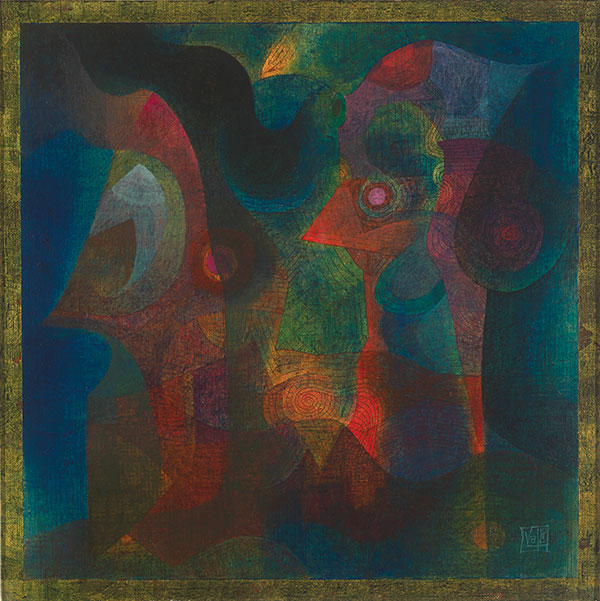
Untitled, 1965, by Alberto Valdés

Field of Moving Colors Layered
I’m not easily mesmerized.
But how can you not be drawn in by swirls,
angles and whorls brought together to obey
a field of moving colors layered, muted    ...    
others bright that make you linger
there?
Just look at those Carpaccio reds.

Right then my mind
leaps to Cezanne:
his dark-blue vest in Self-Portrait (1879–1880);
the Seven Bathers (ca. 1900) wallowing in blue;
his blue beyond in Château Noir (1904).

Consider now the three, or is it four figures
in Alberto Valdés’s Untitled (ca. 1965).
They are wayward energy, moving right
to left (the right one more sensuous than the rest)
about to dive
into the deep-blue waiting — call it the unknown.
I’d like to be there when they meet that blue abyss
head on.
Will they keep their shape, I wonder,
or break up and rearrange themselves
into a brighter, more memorable pose
...    into a bigger elemental thing?

I’m really asking this:
When they run into the landscape of  blue,
will these figures lose their logic of  luster?
Will they lose their lucid argument of color,
their accumulated wealth of geometry?
Will they still engage the entire me,
hold me,
keep me mesmerized?


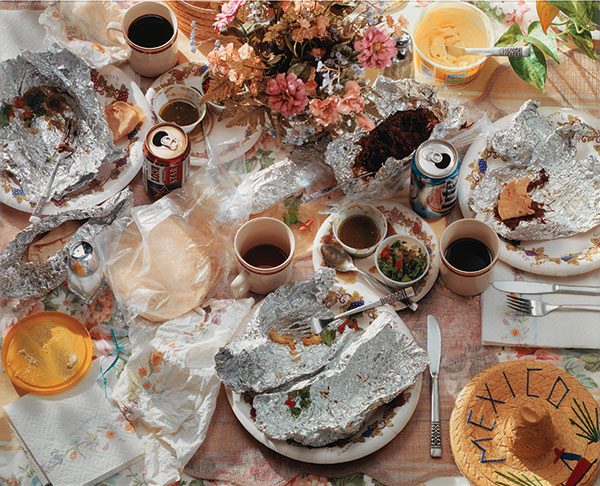
Breakfast Tacos, from the series Seven Days, 2003, by Chuck Ramirez


Last Meal: Breakfast Tacos, San Antonio, Tejas

Let me be your last meal.
Let me harvest the notes
I took from your mother’s
watery hands, street vendors
in Rome, Ms. Rosie
from our taquería, you:
in the sun, in the open air,
let me give you zucchini
and their elusive blossoms —
my arms, my hands.
Pumpkiny empanadas
of my feet, pulpy as a newborn’s.
Guisada’d loin of my calf
muscle. On a plate white
and crisp as the ocean,
lemoned eyeballs like two
scallops. The red, ripe
plum of my mouth.
Perhaps with coffee,
you’d have the little lobe
of my ear sugared as a wedding
cookie. The skin of my belly,
my best chicharrón, scrambled
with the egg of my brain
for your breakfast tacos.
My lengua like lengua.
Mi pescuezo, el mejor hueso.
Let me be your last meal:
mouthfuls of my never-to-be-digested
face, my immovable femur
caught in your throat
like a fish bone. Let my body be
what could never leave your body.

Edward Hopper Study: Hotel Room 

While the man is away   
telling his wife   
about the red-corseted woman,   
the woman waits   
on the queen-sized bed.   
You'd expect her quiet   
in the fist of a copper   
statue. Half her face,   
a shade of golden meringue,   
the other half, the dark   
of cattails. Her mouth even—   
too straight, as if she doubted   
her made decision, the way   
women do. In her hands,   
a yellow letter creased,   
like her hunched back.   
Her dress limp on a green chair.   
In front, a man's satchel   
and briefcase. On a dresser,   
a hat with a ceylon   
feather. That is all   
the artist left us with,   
knowing we would turn   
the woman's stone into ours,   
a thirst for the self   
in everything—even   
in the sweet chinks   
of mandarin.


Comments