Making The Modern Artist: Velasquez
Maids of Honor


Las Meninas Introduction to The Order of Things, an Archeology of Knowledge by Michel Foucault.
This reading comes from French theorist Michel Foucault. Like most French theory, it deals in tiny details, and Foucault writes in a typically French style which constantly circles back around on itself to check for holes and to seek a new way of writing appropriate to the content (in this case, the way looking at and representing involve maneuvers of power).
"The painter is standing a little back from his canvas [1]. He is glancing at his model; perhaps he is considering whether to add some finishing touch, though it is also possible that the first stroke has not yet been made. The arm holding the brush is bent to the left, towards the palette; it is motionless, for an instant, between canvas and paints. The skilled hand is suspended in mid-air, arrested in rapt attention on the painter's gaze; and the gaze, in return, waits upon the arrested gesture. Between the fine point of the brush and the steely gaze, the scene is about to yield up its volume.
But not without a subtle system of feints. By standing back a little, the painter has placed himself to one side of the painting on which he is working. That is, for the spectator'at present observing him he is to the right of his canvas, while the latter, the canvas, takes up the whole of the extreme left. And the canvas has its back turned to that spectator: he can see nothing of it but the reverse side, together with the huge frame on which it is stretched. The painter, on the other hand, is perfectly visible in his full height; or at any rate, he is not masked by the tall canvas which may soon absorb him, when, taking a step towards it again, he returns to his task; he has no doubt just appeared, at this very instant, before the eyes of the spectator, emerging from what is virtually a sort of vast cage projected backwards by the surface he is painting. Now he can be seen, caught in a moment of stillness, at the neutral centre of this oscillation. His dark torso and bright face are half-way between the visible and the invisible: emerging from that canvas beyond our view, he moves into our gaze; but when, in a moment, he makes a step to the right, removing himself from our gaze, he will be standing exactly in front of the canvas he is painting; he will enter that region where his painting, neglected for an instant, will, for him, become visible once more, free of shadow and
free of reticence. As though the painter could not at the same time be seen on the picture where he is represented
and also see that upon which he is representing something. He rules at the threshold of those two incompatible
visibilities.
The painter is looking, his face turned slightly and his head leaning towards one shoulder. He is staring at a point
to which, even though it is invisible, we, the spectators, can easily assign an object, since it is we, ourselves, who
are that point: our bodies, our faces, our eyes. The spectacle he is observing is thus doubly invisible: first,
because it is not represented within the space of the painting, and, second, because it is situated precisely in that
blind point, in that essential hiding-place into which our gaze disappears from ourselves at the moment of our
actual looking. And yet, how could we fail to see that invisibility, there in front of our eyes, since it has its own
perceptible equivalent, its sealed-in figure, in the painting itself? We could, in effect, guess what it is the painter
is looking at if it were possible for us to glance for a moment at the canvas he is working on; but all we can see
of that canvas is its texture, the horizontal and vertical bars of the stretcher, and the obliquely rising foot of the
easel. The tall, monotonous rectangle occupying the whole left portion of the real picture, and representing the
back of the canvas within the picture, reconstitutes in the form of a surface the invisibility in depth of what the
artist is observing: that space in which we are, and which we are. From the eyes of the painter to what he is
observing there runs a compelling line that we, the onlookers, have no power of evading: it runs through the real
picture and emerges from its surface to join the place from which we see the painter observing us; this dotted
line reaches out to us ineluctably, and links us to the representation of the picture. In appearance, this locus is a
simple one; a matter of pure reciprocity:
we are looking at a picture in which the painter is in turn looking out at us. A mere confrontation, eyes catching
one another's glance, direct looks superimposing themselves upon one another as they cross. And yet this slender
line of reciprocal visibility embraces a whole complex network of uncertainties, exchanges, and feints. The
painter is turning his eyes towards us only in so far as we happen to occupy the same position as his subject. We,
Foucault does not explain specifically why he thinks the names of the characters don't matter. But he gives hints. Can you grapple with why he believes this, and why he would use this close reading of a painting as the introduction to a book about knowledge and power. the spectators, are an additional factor. Though greeted by that gaze, we are also dismissed by it, replaced by that which was always there before we were: the model itself. But, inversely, the painter's gaze, addressed to the void confronting him outside the picture, accepts as many models as there are spectators; in this precise but neutral place, the observer and the observed take part in a ceaseless exchange. No gaze is stable, or rather in the neutral furrow of the gaze piercing at a right angle through the canvas, subject and object, the spectator and the model, reverse their roles
Foucault does not explain specifically why he thinks the names of the characters don't matter. But he gives hints. Can you grapple with why he believes this, and why he would use this close reading of a painting as the introduction to a book about knowledge and power. the spectators, are an additional factor. Though greeted by that gaze, we are also dismissed by it, replaced by that which was always there before we were: the model itself. But, inversely, the painter's gaze, addressed to the void confronting him outside the picture, accepts as many models as there are spectators; in this precise but neutral place, the observer and the observed take part in a ceaseless exchange. No gaze is stable, or rather in the neutral furrow of the gaze piercing at a right angle through the canvas, subject and object, the spectator and the model, reverse their roles
infinity. And here the great canvas with its back to us on the extreme left of the picture exercises its second
function: stubbornly invisible, it prevents the relation of these gazes from ever being discoverable or definitely
established. The opaque fixity that it establishes on one side renders forever unstable the play of metamorphoses
established in the centre between spectator and model. Because we can see only that reverse side, we do not
know who we are, or what we are doing. Seen or seeing? The painter is observing a place which, from moment
to moment, never ceases to change its content, its form, its face, its identity. But the attentive immobility of his
eyes refers us back to another direction which they have often followed already, and which soon, there can be no
doubt, they will take again: that of the motionless canvas upon which is being traced, has already been traced
perhaps, for a long time and forever, a portrait that will never again be erased. So that the painter's sovereign
gaze commands a virtual triangle whose outline defines this picture of a picture: at the top - the only visible
corner - the painter's eyes; at one of the base angles, the invisible place occupied by the model; at the other base
angle, the figure probably sketched out on the invisible surface of the canvas.
As soon as they place the spectator in the field of their gaze, the painter's eyes seize hold of him, force him to
enter the picture, assign him a place at once privileged and inescapable, levy their luminous and visible tribute
from him, and project it upon the inaccessible surface of the canvas within the picture. He sees his invisibility
made visible to the painter and transposed into an image forever invisible to himself. A shock that is augmented
and made more inevitable still by a marginal trap. At the extreme right, the picture is lit by a window represented
in very sharp perspective; so sharp that we can see scarcely more than the embrasure; so that the flood of light
streaming through it bathes at the same time, and with equal generosity, two neighboring spaces, overlapping but
irreducible: the surface of the painting, together with the volume it represents (which is to say, the painter's
studio, or the salon in which his easel is now set up), and, in front of that surface, the real volume occupied by
the spectator (or again, the unreal site of the model). And as it passes through the room from right to left, this
vast flood of golden light carries both the spectator towards the painter and the model towards the canvas; it is
this light too, which, washing over the painter, makes him visible to the spectator and
urns into golden lines, in the model's eyes, the frame of that enigmatic canvas on which his image, once
transported there, is to be imprisoned. This extreme, partial, scarcely indicated window frees a whole flow of
daylight which serves as the common locus of the representation. It balances the invisible canvas on the other
side of the picture: just as that canvas, by turning its back to the spectators, folds itself in against the picture
representing it, and forms, by the superimposition of its reverse and visible side upon the surface of the picture
depicting it, the ground, inaccessible to us, on which there shimmers the Image par excellence, so does the
window, a pure aperture, establish a space as manifest as the other is hidden; as much the common ground of
painter, figures, models, and spectators, as the other is solitary (for no one is looking at it, not even the painter).
From the right, there streams in through an invisible window the pure volume of a light that renders all
representation visible; to the left extends the surface that conceals, on the other side of its all too visible woven
texture, the representation it bears. The light, by flooding the scene (I mean the room as well as the canvas, the
room represented on the canvas, and the room in which the canvas stands), envelops the figures and the
spectators and carries them with it, under the painter's gaze, towards the place where his brush will represent
them. But that place is concealed from us. We are observing ourselves being observed by the painter, and made
visible to his eyes by the same light that enables us to see him. And just as we are about to apprehend ourselves,
transcribed by his hand as though in a mirror, we find that we can in fact apprehend nothing of that mirror but its
lustreless back. The other side of a psyche.
Now, as it happens, exactly opposite the spectators - ourselves - on the wall forming the far end of the room,
Velazquez has represented a series of pictures; and we see that among all those hanging canvases there is one
that shines with particular brightness. Its frame is wider and darker than those of the others; yet there is a fine
white line around its inner edge diffusing over its whole surface a light whose source is not easy to determine;
for it comes from nowhere, unless it be from a space within itself. In this strange light, two silhouettes are
apparent, while above them, and a little behind them, is a heavy purple curtain. The other pictures reveal little
more than a few paler patches buried in a darkness without depth. This particular one, on the other hand, opens
onto a perspective of space in which recognizable forms recede from us in a light that belongs only to itself.
Among all these elements intended to provide representations, while impeding them, hiding them, concealing
them because of their
position or their distance from us, this is the only one that fulfils its function in all honesty and enables us to see
what it is supposed to show. Despite its distance from us, despite the shadows all around it. But it isn't a picture:
it is a mirror. It offers us at last that enchantment of the double that until now has been denied us, not only by the
distant paintings but also by the light in the foreground with its ironic canvas.
Of all the representations represented in the picture this is the only one visible; but no one is looking at it.
Upright beside his canvas, his attention entirely taken up by his model, the painter is unable to see this lookingglass shining so softly behind him. The other figures in the picture are also, for the most part, turned to face what
must be taking place in front -towards the bright invisibility bordering the canvas, towards that balcony of light
where their eyes can gaze at those who are gazing back at them, and not towards that dark recess which marks
the far end of the room in which they are represented. There are, it is true, some heads turned away from us in
profile: but not one of them is turned far enough to see, at the back of the room, that solitary mirror, that tiny
glowing rectangle which is nothing other than visibility, yet without any gaze able to grasp it, to render it actual,
and to enjoy the suddenly ripe fruit of the spectacle it offers.
It must be admitted that this indifference is equalled only by the mirror's own. It is reflecting nothing, in fact, of
all that is there in the same space as itself: neither the painter with his back to it, nor the figures in the centre of
the room. It is not the visible it reflects, in those bright depths. In Dutch painting it was traditional for mirrors to
play a duplicating role:
they repeated the original contents of the picture, only inside an unreal, modified, contracted, concave space.
One saw in them the same things as one saw in the first instance in the painting, but decomposed and recomposed according to a different law. Here, the mirror is saying nothing that has already been said before. Yet
its position is more or less completely central: its upper edge is exactly on an imaginary line running half-way
between the top and the bottom of the painting, it hangs right in the middle of the far wall (or at least in the
middle of the portion we can see); it ought, therefore, to be governed by the same lines of perspective as the
picture itself; we might well expect the same studio, the same painter, the same canvas to be arranged within it
according to an identical space;
it could be the perfect duplication.
In fact, it shows us nothing of what is represented in the picture itself. Its motionless gaze extends out in front of
the picture, into that necessarily invisible region which forms its exterior face, to apprehend the figures arranged in that space. Instead of
surrounding visible objects, this mirror cuts straight through the whole field of the representation, ignoring all it
might apprehend within that field, and restores visibility to that which resides outside all view. But the
invisibility that it overcomes in this way is not the invisibility of what is hidden: it does not make its way around
any obstacle, it is not distorting any perspective, it is addressing itself to what is invisible both because of the
picture's structure and because of its existence as painting. What it is reflecting is that which all the figures. within the painting are looking at so fixedly, or at least those who are looking straight ahead; it is therefore what
the spectator would be able to see if the painting extended further forward, if its bottom edge were brought lower
until it included the figures the painter is using as models. But it is also, since the picture does stop there,
displaying only the painter and his studio, what is exterior to the picture, in so far as it is a picture - in other
words, a rectangular fragment of lines and colours intended to represent something to the eyes of any possible
spectator. At the far end of the room, ignored by all, the unexpected mirror holds in its glow the figures that the
painter is looking at (the painter in his represented, objective reality, the reality of the painter at his work); but
also the figures that are looking at the painter (in that material reality which the lines and the colours have laid
out upon the canvas). These two groups of figures are both equally inaccessible, but in different ways: the first
because of an effect of composition peculiar to the painting; the second because of the law that presides over the
very existence of all pictures in general. Here, the action of representation consists in bringing one of these two
forms of invisibility into the place of the other, in an unstable superimposition - and in rendering them both, at
the same moment, at the other extremity of the picture - at that pole which is the very height of its
representation: that of a reflected depth in the far recess of the painting's depth. The mirror provides a metathesis
of visibility that affects both the space represented in the picture and its nature as representation;
it allows us to see, in the centre of the canvas, what in the painting is of necessity doubly invisible.
A strangely literal, though inverted, application of the advice given, so it is said, to his pupil by the old Pachero
when the former was working in his studio in Seville: 'The image should stand out from the frame.'
But perhaps it is time to give a name at last to that image which appears in the depths of the mirror, and which
the painter is contemplating in front of the picture. Perhaps it would be better, once and for all, to determine the
identities of all the figures presented or indicated here, so as to avoid embroiling ourselves forever in those
vague, rather abstract designations, so constantly prone to misunderstanding and duplication, 'the painter', 'the
characters', 'the models', 'the spectators', 'the images'. Rather than pursue to infinity a language inevitably
inadequate to the visible fact, it would be better to say that Velazquez composed a picture; that in this picture he
represented himself, in his studio or in a room of the Escurial, in the act of painting two figures whom the
Infanta Margarita has come there to watch, together with an entourage of duennas, maids of honour, courtiers,
and dwarfs; that we can attribute names to this group of people with great precision: tradition recognizes that
here we have Dona Maria Agustina Sarmiente, over there Nieto, in the foreground Nicolaso Pertusato, an Italian
jester. We could then add that the two personages serving as models to the painter are not visible, at least
directly; but that we can see them in a mirror; and that they are, without any doubt, King Philip IV and his wife,
Mariana.
First, it is the reverse of the great canvas represented on the left. The reverse, or rather the right side, since it
displays in full face what the canvas, by its position, is hiding from us. Furthermore, it is both in opposition to
the window and a reinforcement of it. Like the window, it provides a ground which is common to the painting
and to what lies outside it. But the window operates by the continuous movement of an effusion which, flowing
from right to left, unites the attentive figures, the painter, and the canvas, with the spectacle they are observing;
whereas the mirror, on the other hand, by means of a violent, instantaneous movement, a movement of pure
surprise, leaps out from the picture in order to reach that which is observed yet invisible in front of it, and then,
at the far end of its fictitious depth, to render it visible yet indifferent to every gaze. The compelling tracer line,
joining the reflection to that which it is reflecting, cuts perpendicularly through the lateral flood of light. Lastly
-and this is the mirror's third function - it stands adjacent to a doorway which forms an opening, like the mirror
itself, in the far wall of the room. This doorway too forms a bright and sharply defined rectangle whose soft light
does not shine through into the room. It would be nothing but a gilded panel if it were not recessed out from the
room by means of one leaf of a carved door, the curve of a curtain, and the shadows of several steps. Beyond the
steps, a corridor begins; but instead of losing itself in obscurity, it is dissipated in a yellow dazzle where the
light, without coming in, whirls around on itself in dynamic repose. Against this background, at once near and
limitless, a man stands out in full-length silhouette; he is seen in profile; with one hand he is holding back the
weight of a curtain; his feet are placed on different steps; one knee is bent. He may be about to enter the room; or
he may be merely observing what is going on inside it, content to surprise those within without being seen himself. Like the mirror, his eyes are directed towards the other side of the scene; nor is anyone paying any more
attention to him than to the mirror. We do not know where he has come from: it could be that by following
uncertain corridors he has just made his way around the outside of the room in which these characters are
collected and the painter is at work;

Velasquez, Las Meninas (The Maids of Honor), 1656
 |
| Velasquez, portrait of Mariana of Austria, 1652, 92x52" |
 |
| Rembrandt van Rijn, Artist in the Studio, 1629, (9.8 in × 12.5 in) |
fyi... the rembrandt is tiny, 9" high; the velazquez is giant, 125 " high!I think I've still made the rebrandt too big by comparison!
 |
| Vermeer, Allegory of Painting, 1668 |

 |
| source |


Jan Van Eyck, Arnolfini Double Portrait, 1434, 23 x 31 oil on canvas

8
. Key from Wikipedia.
- (1) Infanta Margarita Teresa of Spain
- (2) doña Isabel de Velasco
- (3) doña María Agustina Sarmiento de Sotomayor
- (4) the Austrian court dwarf, Maribarbola (Maria Barbola), with achondroplastic dwarfism
- (5) the Italian court dwarf, Nicolas Pertusato, with hypophyseal dwarfism
- (6) doña Marcela de Ulloa, the infanta's governess, in mourning dress
- (7) unidentified bodyguard (guardadamas)
- (8) Don José Nieto Velázquez, the queen's chamberlain
- (9) Velázquez
- (10) King Philip IV reflected in mirror
- (11) Queen Mariana of Austria, reflected in mirror
- and the Spanish mastifff.


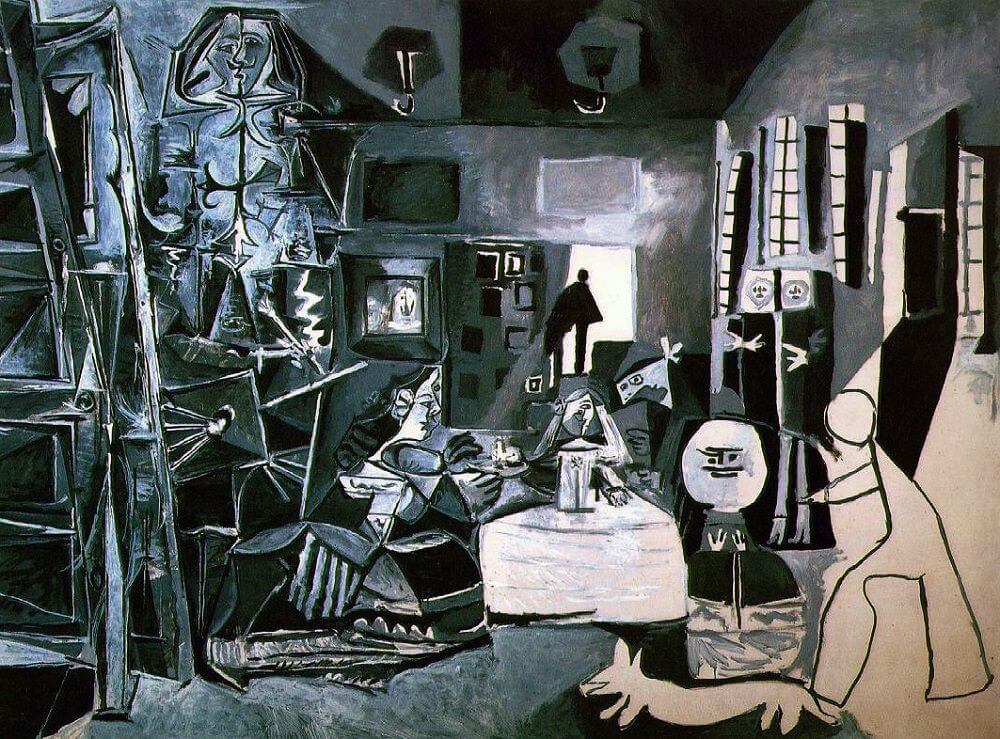 |
| Pablo Picasso, Las Meninas, 1957 |
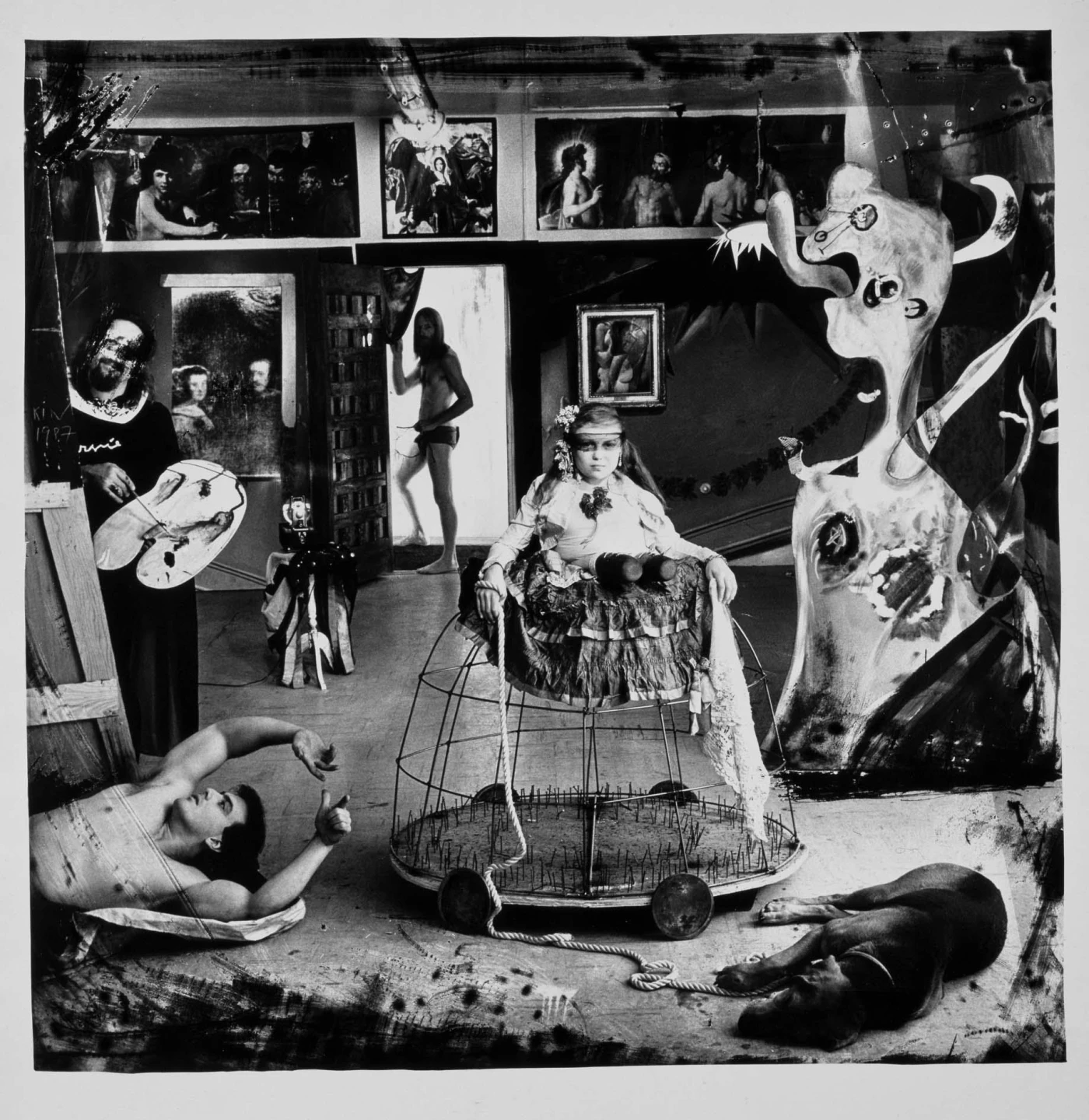 |
| Joel Peter Witkin, Las Meninas (Self Portrait), 1987 |
Eve Sussman, 89 Seconds at Alcazar, 2003
Manolo Valdés, Las Meninas, 2007
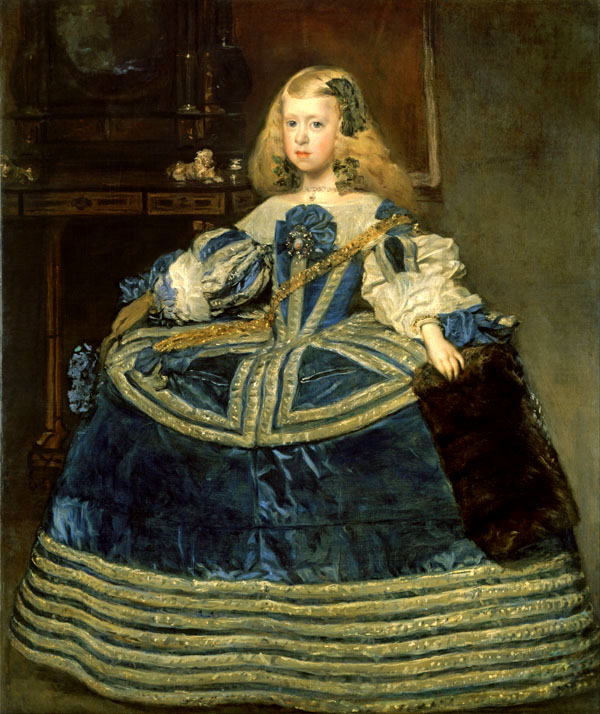 |
| Diego Velasquez, The Infanta Margarita, 1659, 8 years old |
![Las Meninas [Infanta Margarita María] | Picasso museum Barcelona | Official website](https://colleccions.eicub.net/api/1/images/https%3A%2F%2Fdobubt4dam3m5.cloudfront.net%2Fpublic%2FHeritageObject%2FH290703%2F54947%2Ffull%2Foriginal%2F0%2Fdefault.jpg) |
| Picasso, Infanta Margarita, 1957 |
 |
| Julie Heffernan, Self-Portrait as Infanta ;Maria Teresa Dreaming Madame de Sade, 1999, oil on canvas, 67 x 58 inches |
 |
Yasumasa Morimura, Daughter of Art History, 1989 |
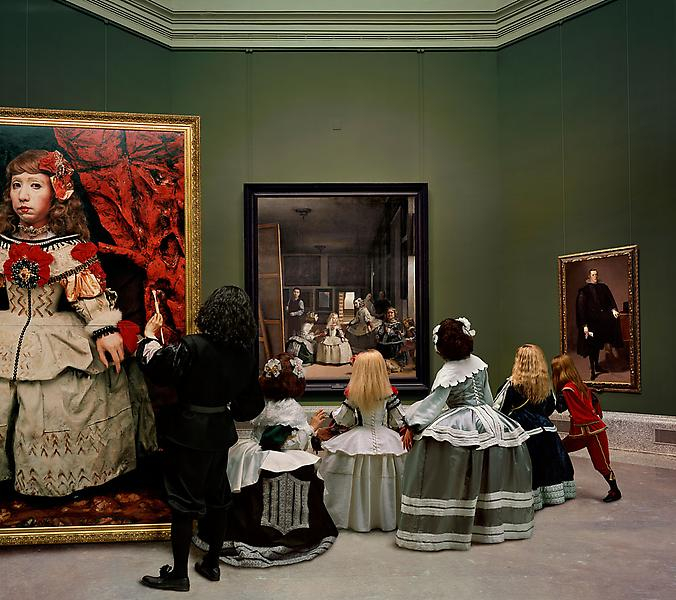 |
| Yasumasa Morimura Las Meninas renacen de noche IV: Peering at the secret scene behind the artist, 2013 C-print Edition of 5 and 2 artist’s proofs 58 1/4 x 65 3/4 inches (148 x 167 cm) here's the entire amazing series at Luring Augustine |

 |
| Diane Arbus, MExican Dwarf in his Hotel Room |
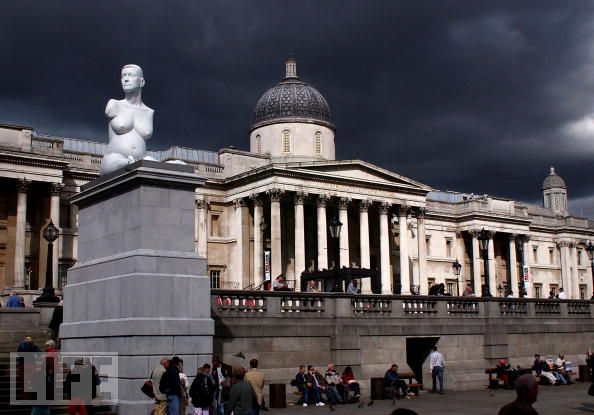 |
| Marc Quinn, Alison Lapper Pregnant, 2011modeled on the artist Alison Lapper—then at eight months' gestation—who also has a medical condition called phocomelia. The "fourth plinth" is a platform in the square originally intended for equestrian sculpture but never used as such. It sat empty for many years, and it's now the site of specially commissioned public works. |
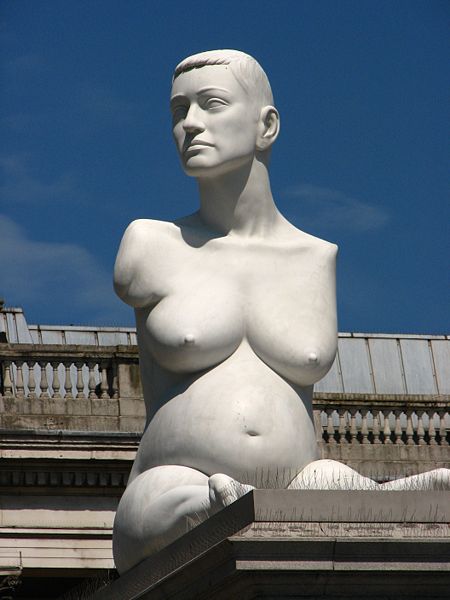 |
| Marc Quinn, Alison Lapper Pregnant, 2011modeled on the artist Alison Lapper—then at eight months' gestation—who also has a medical condition called phocomelia. The "fourth plinth" is a platform in the square originally intended for equestrian sculpture but never used as such. It sat empty for many years, and it's now the site of specially commissioned public works. |
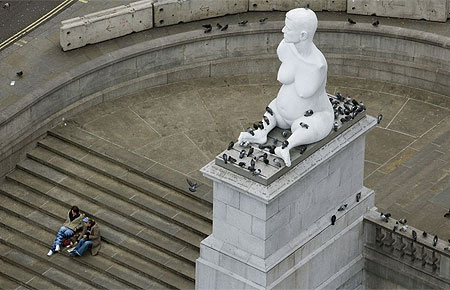 |
| Marc Quinn, Alison Lapper Pregnant, 2011modeled on the artist Alison Lapper—then at eight months' gestation—who also has a medical condition called phocomelia. The "fourth plinth" is a platform in the square originally intended for equestrian sculpture but never used as such. It sat empty for many years, and it's now the site of specially commissioned public works. |
 |
| Mary Duffy, Coastguard Cottage, nd Primarily a landscape painter, some time ago, I found myself at a point of transition. While still wanting to be deeply engaged in painting, circumstances have forced me to work more from my memory of places, rather than directly on site. This move lead me to discover cold wax as a new medium to work with and it has forced me tease out exactly what I was looking for. As a result of working indoors and from memory, my paintings have mostly become bigger, more abstract.
This shift came from a desire not to just paint places or things, but rather to use the paint itself to express the essence of space and place, and my response to it. I am allowing the paint to lead me now as much as the landscape led me in the past. |
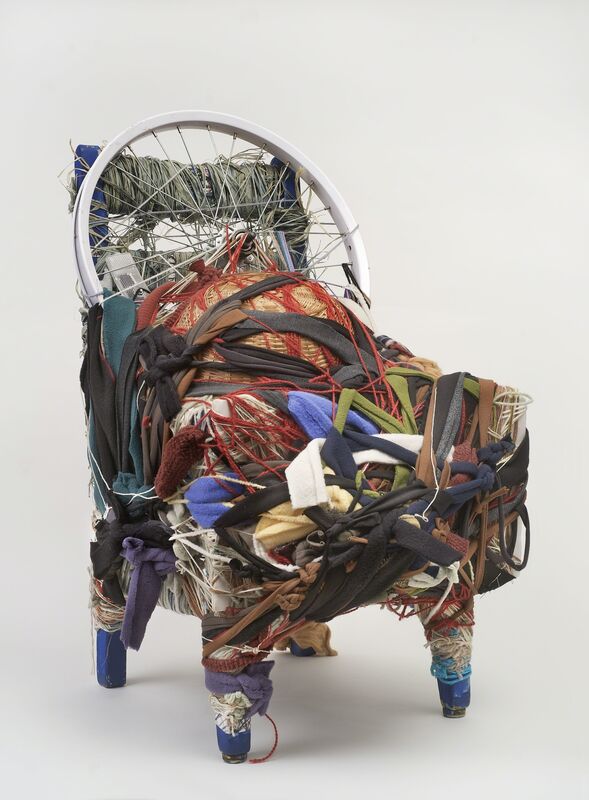 |
| Judith Scott, Untitled, 2004 Fiber and found objects 29 × 16 × 21 in | 73.7 × 40.6 × 53.3 cm |
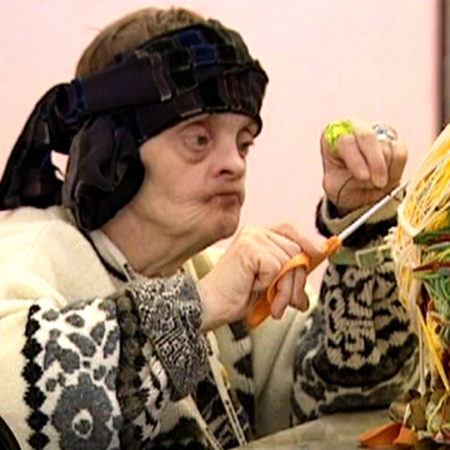 |
| Judith Scott and Creative Growth Art Center on Art21 |
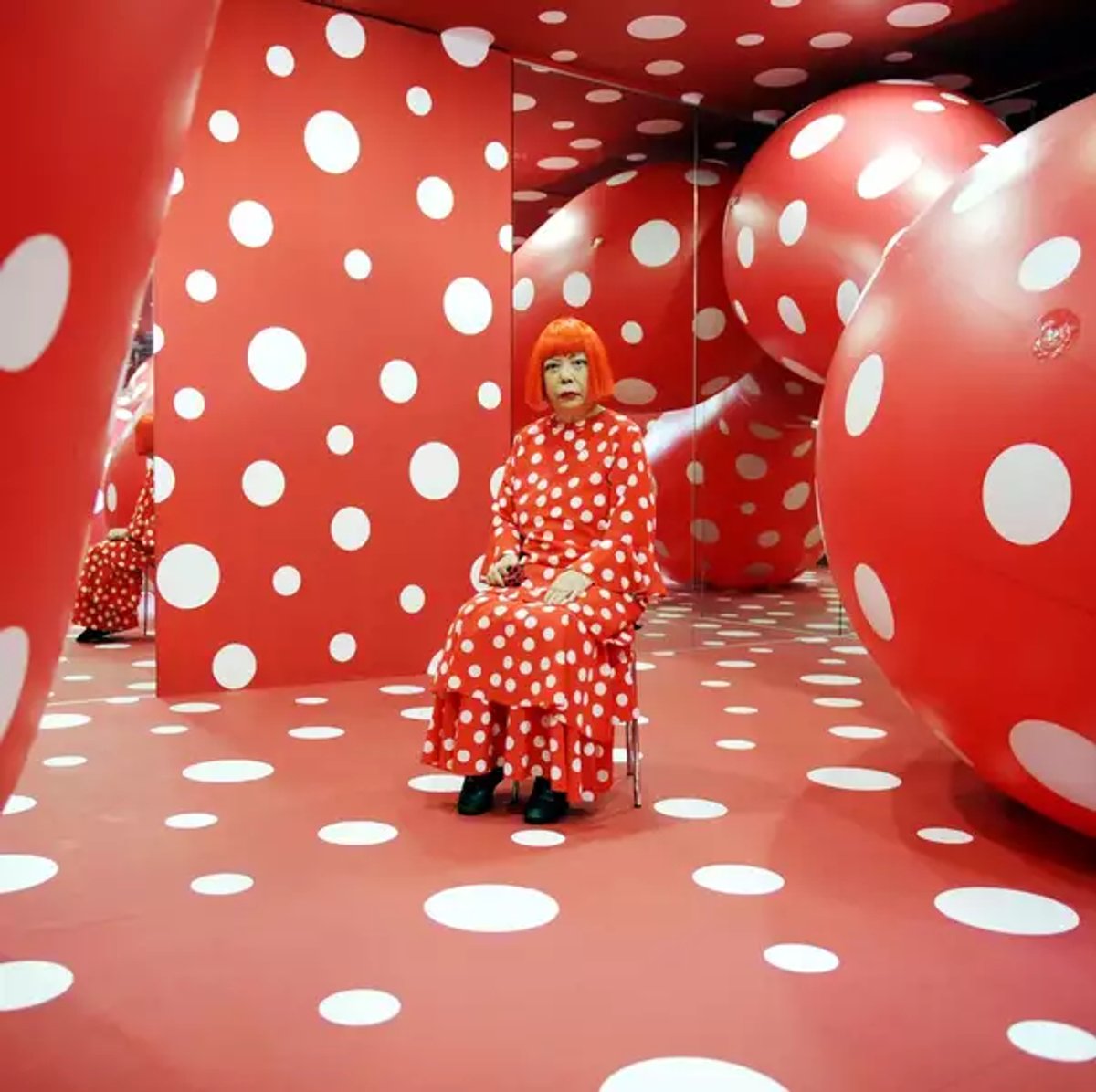 |
| Yayoi Kusama and Dots Obsession, 1996-2011 Installation view: The Watari Museum of Contemporary Art, Tokyo. |
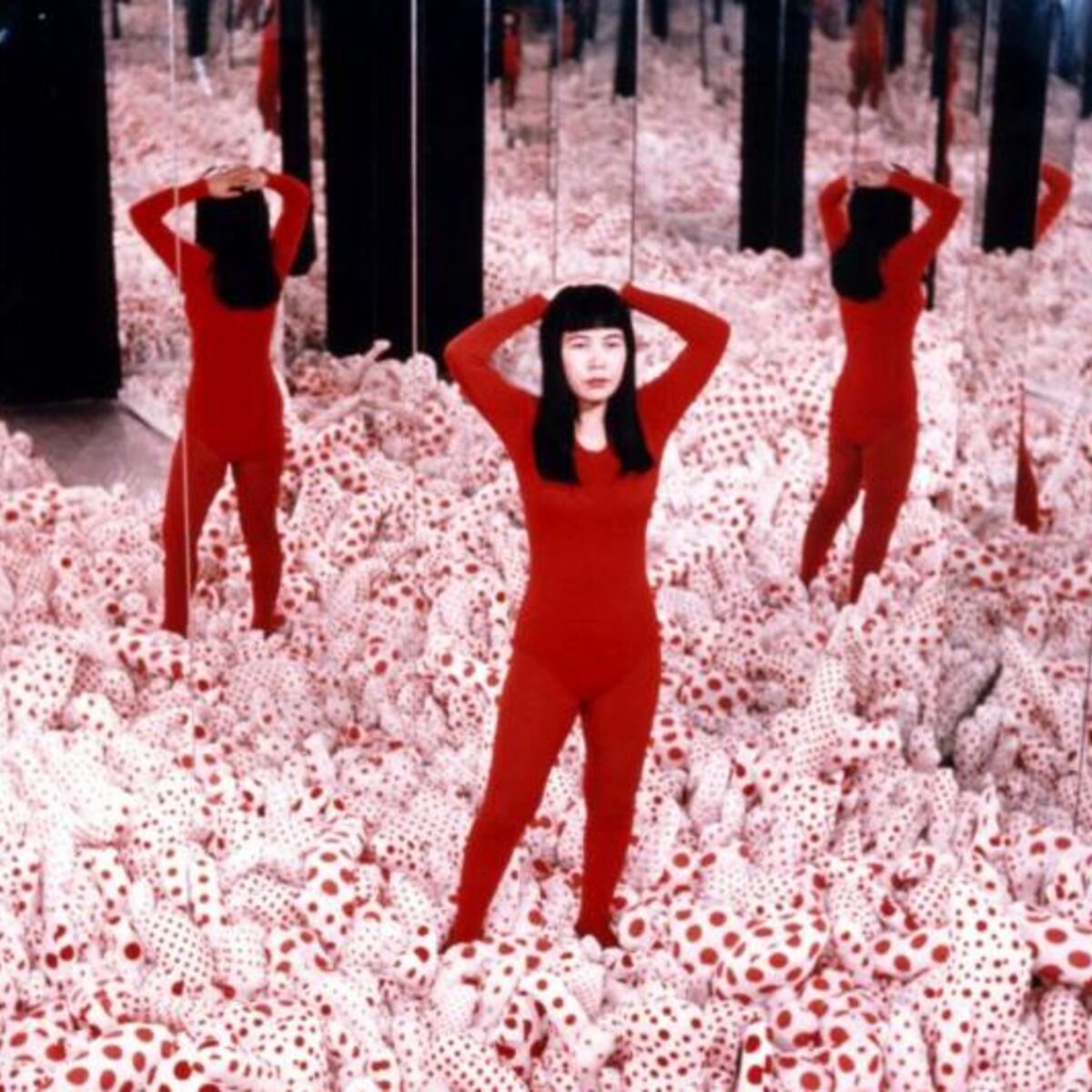 |
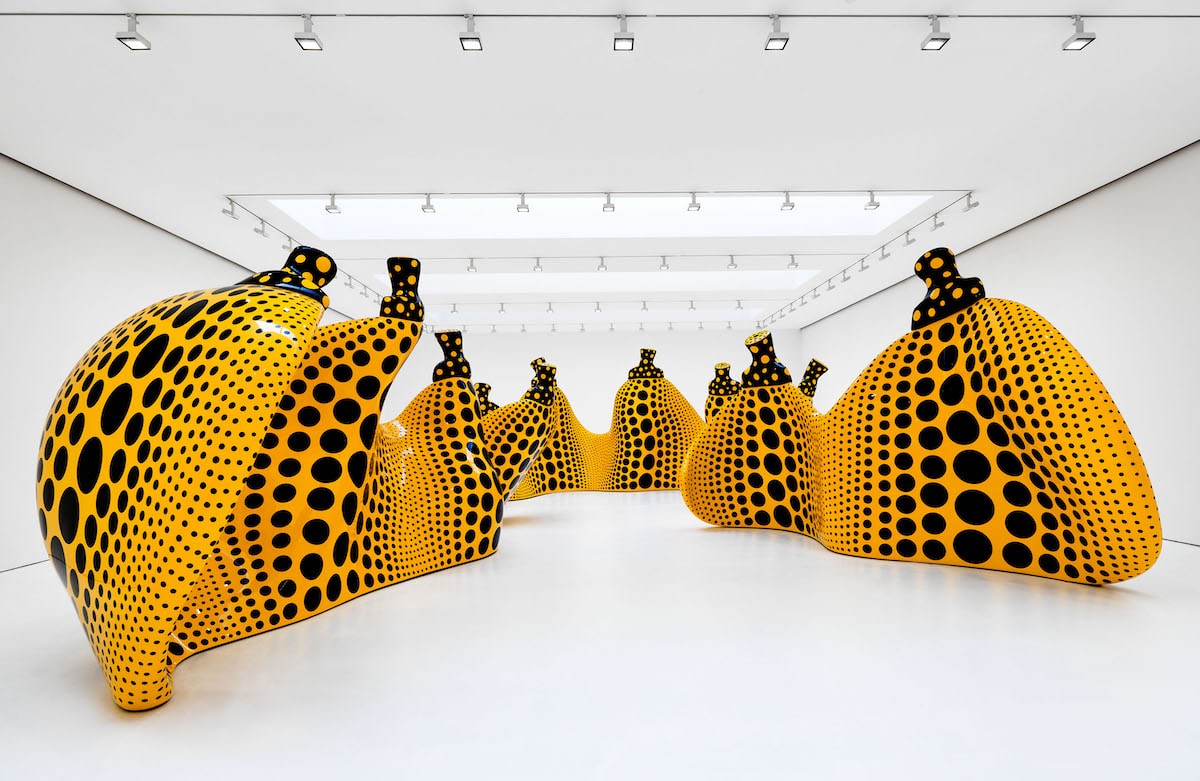 |
| Installation view, “Yayoi Kusama: I Spend Each Day Embracing Flowers, David Zwirner, New York, May 11–July 21, 2023 |
Yayoi Kusama
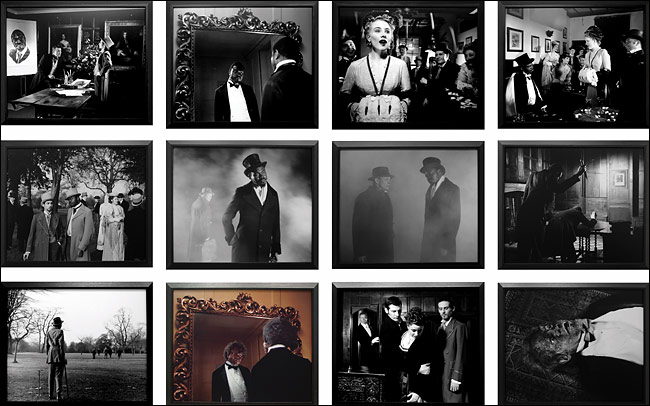
| Yinka Shonibare, from Dorian Gray, photo series, 2001. |
| Yinka Shonibare, Diary of a Victorian Gentleman, printed 2012 |
 |
| WILLIAM HOGARTH, A Harlots Progress, 1697-1764 Etchings with engraving 1733 |
| yinka Shonibare, The Swing (after Fragonard, 2001 |
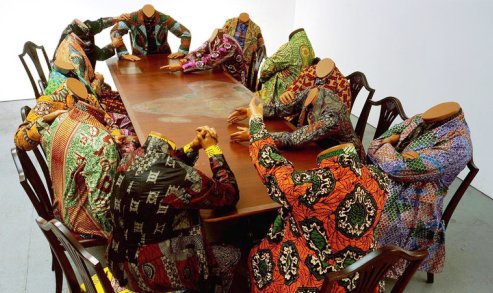 |
| Yinka Shonibare |
Comments
Post a Comment